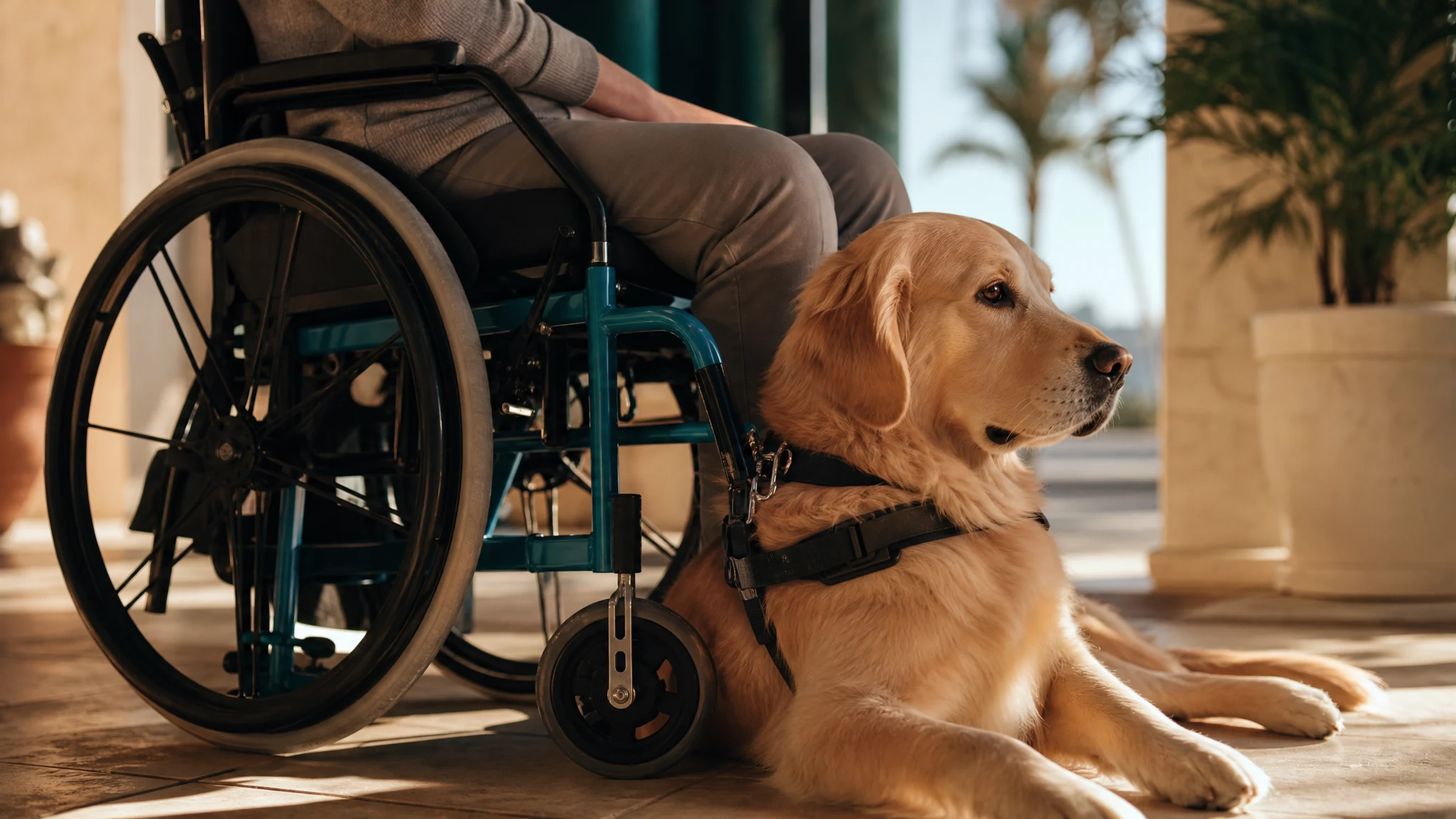
ESA vs Service Dog in Florida: Rights, Access and Documents
Florida owners often use "service animal" and "emotional support animal" as if they meant the same thing. Under federal and Florida law they do not. The two differ in training, in where the animal may go, and in the paperwork behind each. This guide sets out the Florida service animal laws and the rules for an emotional support animal (ESA) side by side, so you can see which framework fits your situation. The point is to explain each, not to push you toward either.
Read this first: ESA registration is a separate, optional service. It is not a substitute for an ESA letter, and it gives you no ESA rights or any additional rights. Housing rights come only from a letter written by a licensed health care or telehealth practitioner. Florida Statute 760.27 also says an online registration alone is not sufficient documentation.
This article is informational. It is not medical, mental-health or legal advice. A Florida-licensed clinician can tell you whether an ESA is therapeutically appropriate for you. For a housing dispute, speak with a Florida-licensed attorney or your local legal aid office.

The Core Difference Between ESAs and Service Dogs: Training Versus Companionship
A service animal under Florida law, Section 413.08 of the Florida Statutes, is a dog (in some cases a miniature horse) individually trained to do work or perform tasks for a person with a disability. Examples are guiding someone who is blind, alerting to a seizure, or interrupting a harmful behavior during a psychiatric episode. The training is what defines the animal. Comfort alone does not make a dog a service dog.
An emotional support animal is different. An ESA is not defined by task training. It is a companion animal that a licensed clinician has determined may help ease symptoms of a person's condition. The animal's role is its presence, not a trained task, and the species is not limited to dogs. This difference explains almost every contrast in the sections below.
ADA vs FHA: Which Law Covers What for ESAs in Florida
Two federal frameworks matter here, and they protect different things.
- The Americans with Disabilities Act (ADA) covers trained service animals in public places such as restaurants, shops, hotels, hospitals and public transit. It applies to service animals, not to ESAs.
- The Fair Housing Act (FHA) covers housing. It lets a person with a disability request a reasonable accommodation for an assistance animal, which includes both service animals and ESAs. HUD's notice FHEO-2020-01, "Assessing a Person's Request to Have an Animal as a Reasonable Accommodation Under the Fair Housing Act," is the federal guidance on how housing providers should evaluate those requests.
Put simply, an ESA's legal footing is housing, and a service dog's footing is housing plus public access. That is the central point in any ESA vs service dog comparison in Florida.
Florida Service Animal Laws: Section 413.08 and Public Access
Florida service dog laws are found mainly in s. 413.08. The statute gives a person with a disability who is accompanied by a service animal the right to enter public accommodations, including restaurants, stores, and transport in cities from Jacksonville to Key West. A few practical points follow from it:
- Staff may ask only two things: whether the animal is required because of a disability, and what work or task it has been trained to perform. They may not demand medical records, a special ID or a demonstration.
- The animal must be under the handler's control and housebroken. A business may ask for the animal to be removed if it is out of control or not housebroken.
- Public access belongs to service animals only. An ESA does not carry a right to enter restaurants, grocery stores or other places that bar pets.
Section 413.08 also makes it a second-degree misdemeanor to knowingly misrepresent a pet as a service animal in order to claim public access. Florida takes this seriously because fake claims make life harder for handlers with real service dogs. Do not describe an ESA as a service dog to get into a business.
ESA Housing Rules: Florida Statute 760.27
Florida Statute 760.27 deals with assistance animals in housing. It is the state's companion to the federal FHA and governs the documentation a housing provider may rely on. Two features matter for ESA owners:
- The clinician must be Florida-licensed. The statute looks to a health care or telehealth practitioner who is licensed in Florida, or who has an established prior in-person relationship with you. Online-only providers licensed in other states cannot issue a valid Florida ESA letter.
- Online registration alone is not enough. A certificate, ID card or registry listing bought online does not count as sufficient documentation by itself.
Florida also has Section 817.265, which addresses knowingly giving false information to claim an ESA in housing. For the full picture of who may write a letter and what it should contain, see our guide on ESA letter requirements in Florida and who can write one. For broader background, our complete 2026 guide to emotional support animals in Florida covers the topic in more depth.

Comparison Table: ESA vs Service Dog in Florida
| Attribute | Emotional Support Animal | Service Dog |
|---|---|---|
| Main legal framework | Fair Housing Act, Florida Statute 760.27 | ADA, Florida s. 413.08, and the FHA for housing |
| Training required | No task training required, but good behavior is expected | Individually trained to do work or tasks tied to a disability |
| Species | Not limited to dogs | Dogs (and in some cases miniature horses) |
| Housing | May be requested as a reasonable accommodation | May be requested as a reasonable accommodation |
| Public access (stores, restaurants) | No | Yes, under s. 413.08 and the ADA |
| Air travel | No. Airlines treat ESAs as pets since the DOT's 2021 rule change | Handled under separate DOT service animal rules |
| Key document | Letter from a Florida-licensed health care or telehealth practitioner | No letter required for public access. Only the two permitted questions may be asked |
| Misrepresentation risk | Section 817.265 concerns false claims in housing | Second-degree misdemeanor under s. 413.08 |
Pros and Cons of an Emotional Support Animal
Pros in Florida
- No task training is required, so a pet you already love may qualify if a clinician finds it appropriate.
- It offers housing protection that can matter in pet-restricted rentals and communities.
- The path to eligibility runs through a clinician conversation, not a training program.
Cons in Florida
- It has no public access rights, so it cannot go into restaurants or shops that exclude pets.
- It has no air-travel protection.
- Housing providers may ask for reliable documentation, and an invalid letter can cause delays or denial.
Pros and Cons of a Service Dog in Florida
Pros in Florida
- It has broad public access under s. 413.08 and the ADA.
- It performs trained tasks that can directly support daily functioning.
- Staff can ask only two questions, so no paperwork is demanded at the door.
Cons in Florida
- Training takes significant time, effort and often money.
- The dog must stay under control and housebroken at all times in public.
- Misrepresenting a pet as a service animal is a second-degree misdemeanor in Florida.
Florida Heat, Hurricane Season and Condo Living: How They Shape the Choice
Florida conditions affect this decision more than most guides admit. Summer heat and humidity can make midday outdoor walks hard on any animal, and that is especially true for flat-faced or heavy-coated breeds. Many owners in Orlando and Naples pick short-coated or heat-suited companions for year-round outdoor walking. Heat also matters for service dogs working in public: pavement can burn paws, and a dog that cannot settle in a hot lobby is not serving its handler well.
Hurricane season, from June to November, adds another layer. Evacuation planning is different for each type of animal. Many public shelters accept pets only in designated areas, and a person relying on an ESA at home needs a plan for where the animal goes if they evacuate to a hotel or relative's home. Service dogs are generally allowed to stay with their handlers, but a handler still needs supplies and veterinary records ready. Coastal flooding in places like Miami-Dade and the Gulf Coast can strand people and pets alike, so identification and a lost-pet plan matter whichever route you take.
Condos and HOAs are another Florida-specific concern. Many communities limit pets by size, breed or number, and tourist and snowbird rental markets add seasonal turnover and stricter building rules. This is where ESA documentation usually comes into play. A valid letter from a Florida-licensed practitioner is what a housing provider may consider under the FHA and s. 760.27, and the housing provider still evaluates each request individually.
Where ESA Registration Fits In (and Where It Does Not)
Because this site focuses on ESA registration, it helps to be precise about what registration is. It is a separate, optional service. It is not a letter, and it does not create legal rights under the Fair Housing Act or Florida Statute 760.27. To register you must also hold an ESA letter and be eligible for an emotional support animal. Registration sits alongside the letter and never replaces it.
The benefits are practical:
- Lifetime registration per pet in the ESA and lost-pet recovery database, which can help shelters reunite you with a lost pet. For Florida owners facing storms and evacuations, this is the most useful benefit.
- An animal ID card and certificate you can display. They carry no legal housing rights.
- $25 off an ESA letter consultation if you still need a letter.
- Access to a legal support team if your Fair Housing Act rights are violated. This covers housing matters only.
- A registry listing that a landlord may look up to see you worked with a legitimate company. No landlord is required to use the registry or accept it.
There are three steps: (1) submit your contact information and confirm you meet the ESA requirements; (2) submit your animal's information and upload a photo; (3) receive your animal ID and certificate by mail and unlock lost-pet recovery and legal support. Be wary of generic online sellers who charge a small fee for an official-looking certificate and imply it is all you need. Under s. 760.27, it is not.
Best for: ESA and Service Dog Recommendations by Use Case in Florida
- You want help with housing for a companion animal and have no need for public access: an ESA, supported by a letter from a Florida-licensed practitioner, may fit. Whether it is appropriate is for your clinician to decide.
- You need a dog trained to perform specific tasks in public: a service dog is built for this, and s. 413.08 governs access.
- You rent in a Florida condo or HOA with pet limits: either framework may support a housing request, but the documentation paths differ. For an ESA, that means a valid letter.
- You want a safety net for a lost pet during storm season: ESA registration's lost-pet recovery database can help, as an add-on to a letter.
- You plan to fly: an ESA no longer has Air Carrier Access Act protection. Talk to your clinician about psychiatric service dog options and your airline's pet policy.
The Verdict on ESAs and Service Dogs in Florida
Neither option is better in the abstract. They answer different needs. A service dog is a trained working animal with public access rights under s. 413.08 and the ADA. An ESA is a companion with housing protections under the Fair Housing Act and Florida Statute 760.27, backed by a letter from a Florida-licensed clinician.
If the question is whether you can take your animal into stores and restaurants, only a service dog qualifies. If the question is keeping a companion animal in your home despite a pet restriction, an ESA letter is the relevant document. Registration is an optional extra for ESA owners: useful for lost-pet recovery and legal support, but never a replacement for the letter. Whichever route you consider, do not misrepresent an animal's status. Both Florida laws carry penalties for it.
If you want to find out whether an ESA evaluation is right for you, you can start with our Florida intake. A licensed clinician will evaluate you individually, and approval is never automatic.
Important Disclaimer About ESAs in Florida
This article is for general information only. It is not medical, mental-health or legal advice, and laws and agency guidance change. Consult a Florida-licensed mental health professional about whether an ESA may be appropriate for you, and consult a Florida-licensed attorney, or your local legal aid office, for any landlord or housing dispute. Review the current text of Florida Statutes 413.08, 760.27 and 817.265, and HUD notice FHEO-2020-01, before relying on any summary.
Ready to Start Your Florida ESA Letter?
Licensed Florida clinician review. Compliant with state law.
Register My Florida ESA